Last updated November 18, 2026
ADU Cost Breakdown: The Sunrise Manor Homeowner’s Reference for 2026
Clark County’s sewer connection fee alone can add $8,000 – $22,000 to an ADU budget depending on the parcel’s existing lateral size. That single line item, almost never mentioned in online cost guides, is the most common reason Sunrise Manor ADU budgets blow up at the permit stage. The $150,000 price you see quoted everywhere is a national median. It understates what Sunrise Manor homeowners actually pay for utility connections and mechanical systems, and overstates a few other categories that are cheaper here than the internet suggests. This guide rebuilds the number from Clark County’s real fee schedules, Nevada utility charges, and caliche-soil foundation costs.
Quick Answer
A 600-square-foot ADU in Sunrise Manor typically runs $145,000 to $250,000 in 2026, or roughly $240 to $420 per square foot, depending on the build method and finish level. The base structure and finishes account for 70 – 75% of that number; Clark County permits, NVEnergy upgrades, SNWA water meter work, and caliche-soil foundations make up the rest, and they’re the figures most guides leave out. A prefab unit from a brand like Abodu or Cover usually lands lower than stick-built on the same lot once soft costs are included.
Table of Contents
- Line-Item Cost Table: Sunrise Manor 2025 – 2026 Figures
- The Two Categories That Blow Up Sunrise Manor Budgets
- Foundation Costs in Caliche Soil vs. Normal Soil
- Prefab vs. Stick-Built: Cost Per Square Foot by Brand
- The Three Cost Variables You Control (and Three You Don’t)
- Financing Options for Nevada Homeowners
- The Honest Break-Even Math on Rental Income
- How the Permit and Build Sequence Actually Runs
Line-Item Cost Table: Sunrise Manor 2025 – 2026 Figures
Here’s where the money goes for a typical 600-square-foot detached ADU on a Sunrise Manor lot. These are ranges, not quotes; your parcel’s existing utilities, soil and access will move them. We’ve watched enough of these go through Clark County to know that the site-work line varies more than any other part of the budget.
- Structural shell and finishes: $95,000 – $170,000 (the bulk of the budget)
- Clark County building permit fees: $3,200 – $7,500, scaled to square footage and valuation
- Clark County sewer connection fee: $8,000 – $22,000, driven by the existing lateral size and whether a new tap is required
- SNWA water meter upsize: $1,800 – $6,000, depending on meter size and connection type
- NVEnergy service upgrade or new drop: $2,500 – $9,000, higher if a transformer is needed
- Foundation in caliche soil: $14,000 – $28,000; standard soil runs $9,000 – $18,000
- Site prep, grading, and access: $3,000 – $11,000
- Design, engineering, and survey: $4,500 – $12,000
- Mechanical, electrical, plumbing rough and finish: $18,000 – $38,000
Add those together for a mid-range 600-square-foot build and you land near $165,000. That’s the real Sunrise Manor ballpark, not the $150,000 headline. The reason is utility connections, and the next section explains why.
The Two Categories That Blow Up Sunrise Manor Budgets
Utility connection fees and mechanical systems are the two line items that consistently run higher in Sunrise Manor than in the national cost guides. The first is a fee structure you can’t negotiate. The second is a product of the desert climate.
Utility connections
Clark County’s sewer lateral sizing is the biggest wildcard. If your existing lateral can handle the added fixture load, you’re looking at a fee in the low end of the $8,000 – $22,000 range. If it can’t, the county requires a new tap and the cost jumps toward the top. Older Sunrise Manor parcels, especially those near the original 1950s and 1960s subdivisions off Sahara and Charleston, are the most likely to need a new tap. Homes built later in the 1990s and 2000s along the eastern edge typically have more capacity.
NVEnergy service upgrades are the second piece. An ADU with its own panel and meter needs a separate service drop, and if your main panel is already near capacity, you’re looking at a service upgrade in the $2,500 – $9,000 range. SNWA water meter work adds $1,800 – $6,000 on top.
Mechanical systems in the desert
A 600-square-foot ADU in Sunrise Manor needs a properly sized heat pump, not a window unit. Summer design temperatures here hit 110°F, and a unit that’s undersized will run constantly from June through September. Budget $8,000 – $14,000 for the HVAC alone, plus $2,000 – $4,000 for the electrical panel and $3,000 – $6,000 for plumbing. Cheaper mechanical quotes usually skimp on the cooling capacity, and the homeowner pays for it every summer.
This is where a prefab unit built by a brand like Dvele or Mighty Buildings has an edge: the mechanical package is engineered and priced before the unit ships, so there’s no surprise line item once the foundation is in.
Foundation Costs in Caliche Soil vs. Normal Soil
Sunrise Manor sits on a mix of alluvial soil and caliche, the calcium-carbonate hardpan that forms in desert conditions. Caliche behaves like weak concrete. A standard trench footing that takes hours on normal soil can take days here because the excavator has to break through a layer that doesn’t yield to a normal bucket.
That’s why foundation costs in Sunrise Manor run higher than most national estimates:
- Standard soil foundation (slab or stem wall): $9,000 – $18,000 for 600 square feet
- Caliche soil foundation: $14,000 – $28,000 for the same footprint
- Additional caliche removal and haul-off: $1,500 – $4,500, since the broken hardpan can’t be reused as fill
A soil test before design is the cheapest insurance in the budget. A $600 – $1,200 geotechnical report tells the engineer exactly what the foundation has to handle, and it prevents the change order that shows up when the excavator hits caliche on day two. The foundation is also where prefab ADUs have a hidden advantage: the unit is engineered to a known weight and load pattern, so the foundation design is usually simpler than a stick-built structure with the same footprint.
Prefab vs. Stick-Built: Cost Per Square Foot by Brand
Prefab doesn’t automatically save money. What it does is convert the biggest unknown in construction, the on-site labor and material timeline, into a fixed price you see before work starts. Here’s how the numbers compare across the brands we build with and a stick-built equivalent.
- Boxabl (Casita, ~375 SF): roughly $60,000 – $90,000 installed, or about $160 – $240/SF. The smallest and cheapest option, with a limited finish palette.
- Cover (400 – 600 SF): roughly $130,000 – $180,000, or about $220 – $300/SF. Designed around a panelized system, so delivery is fast.
- Abodu (500 – 700 SF): roughly $160,000 – $230,000, or about $250 – $330/SF. Higher finish level, engineered for permits in advance.
- Dvele (600 – 1,000 SF): roughly $200,000 – $320,000, or about $300 – $380/SF. Net-zero capable, with the mechanical package priced in.
- Mighty Buildings (500 – 700 SF): roughly $180,000 – $260,000, or about $280 – $370/SF. 3D-printed panel construction.
- Stick-built (600 SF, mid-range finish): roughly $170,000 – $250,000, or about $280 – $420/SF once soft costs are included.
The full range, from the smallest Boxabl to the most finished stick-built on a difficult lot, is $160 to $420 per square foot. Where prefab wins is in the middle of the range: a Cover or Abodu build typically prices out 10 – 15% below a comparable stick-built unit in Sunrise Manor, mostly because the on-site labor and weather exposure are shorter. Where it loses is on a lot with unusual site constraints, like a narrow side yard or a long utility run, because the prefab unit is designed to a standard configuration.
If you want to compare the prefab options directly against a stick-built plan, the team at ADU Builders in Sunrise Manor walks through the trade-offs with you at the estimate stage. For projects that are more addition than standalone unit, the Home Addition Contractor in Sunrise Manor page covers the cost structure for attached builds.
The Three Cost Variables You Control (and Three You Don’t)
Knowing which costs respond to your decisions and which don’t is the difference between a budget that holds and one that drifts. Here’s the split.
What you control
- Finish level. The gap between a basic finish package and a designer one is $30,000 – $60,000 on a 600-square-foot unit. Flooring, cabinetry and fixtures are where that money lives. A rental-focused ADU often goes basic on finishes and puts the savings into mechanical quality.
- Site complexity. A flat lot with a wide access path costs far less than a sloping lot with a narrow side yard. If you have two possible ADU locations on your parcel, the one with the shorter utility run and easier equipment access is often $8,000 – $15,000 cheaper.
- Utility distance from the main house. Every foot of trench between the main house and the ADU adds cost for pipe, wire, conduit and backfill. Keeping the ADU within 30 feet of the existing utility stack can save $3,000 – $8,000 alone.
What you don’t control
- Permit fees. Clark County’s fee schedule is set. It scales with square footage and valuation, and there’s no negotiating it.
- Labor market. Southern Nevada’s construction labor costs move with the broader regional market, not with your project. In 2026, licensed trades in the Las Vegas Valley are in steady demand, and labor pricing reflects that.
- Material prices. Lumber, steel and concrete track national markets. James Hardie cladding and other brand materials are priced consistently, but the broader material market isn’t something any builder can lock in for you past the bid date.
The practical takeaway: focus your energy on the first three. That’s where a 10-minute decision at the design table saves five figures later. The last three are the price of building in Sunrise Manor in 2026, and a written price before work starts protects you from any drift in them.
Financing Options for Nevada Homeowners
Very few homeowners pay an ADU in cash. Here are the realistic paths, with payment estimates at current rates. Note that these are rough figures; your actual rate depends on your credit, lender, and loan structure, so confirm the numbers with a lender before you commit.
Home equity line of credit (HELOC)
A HELOC is the most common path for ADU financing in Nevada. You borrow against your home’s equity at a variable rate, typically prime plus a margin. On a $180,000 line at a current variable rate in the 8 – 9% range, interest-only payments run roughly $1,200 – $1,350 per month during the draw period. The advantage is flexibility: you draw as work progresses, so you’re not paying interest on the full amount on day one. The risk is the variable rate; if prime moves, your payment moves with it.
Fannie Mae HomeStyle renovation loan
The HomeStyle loan rolls the ADU cost into your first mortgage. You refinance your existing loan plus the ADU budget into a single 30-year fixed-rate mortgage. On a $180,000 ADU added to an existing $350,000 mortgage at current fixed rates in the 6.5 – 7.5% range, the added principal translates to roughly $1,150 – $1,300 per month over 30 years. The fixed rate is the appeal; the trade-off is a longer closing timeline and an appraisal process that includes the planned ADU.
ADU-specific lenders
A handful of lenders now underwrite ADU projects as their own product, usually with a 10- or 15-year term and a slightly higher rate than a first mortgage. On $180,000 at 8.5% over 15 years, the payment lands around $1,770 per month. These loans close faster than a HomeStyle but generally cost more over the life of the loan.
Whatever path you choose, get the written price from your builder before you finalize the loan. A lender will want a fixed scope document, and a verbal estimate won’t get through underwriting. That’s the reason we put the price in writing from the first conversation; it’s the document the loan process is built around.
The Honest Break-Even Math on Rental Income
The “your ADU pays for itself in rental income” line gets repeated everywhere, and it’s almost always optimistic. Here’s the honest version using Sunrise Manor’s actual 2026 rental market.
A 400 – 600 square foot ADU in Sunrise Manor rents for roughly $1,100 – $1,600 per month. That’s the going rate for comparable units in the neighborhood. Let’s use the middle of the range, $1,350 per month, and a 600-square-foot build at $180,000.
- Gross annual rent: $1,350 × 12 = $16,200.
- Vacancy and turnover allowance (about 5%): subtract $810, leaving $15,390.
- Operating costs (maintenance, insurance, property tax bump, utilities the tenant doesn’t pay): subtract roughly $3,000 – $4,500, leaving about $11,000 – $12,400 net per year.
- Break-even on $180,000: 180,000 ÷ 11,700 ≈ 15.4 years, before financing costs.
With a HELOC at 8.5%, the first several years of rent go mostly to interest, so the true break-even stretches to roughly 20 years if you finance the full build. The payoff isn’t that the ADU is a fast profit machine. It’s that you own an appreciating asset that carries most of its own operating costs, and the rent covers the carrying cost while the property value grows. If you’re building the ADU for family, the math is simpler: you’re buying housing, not an investment return.
Use this as a starting template, not a promise. Plug in your own financing rate and the rental rate you can actually confirm for a comparable unit nearby, and you’ll have a number you can trust. The team at Room Addition Contractor in Sunrise Manor can help you scope a smaller ADU that fits the rental market, and the Benson ADU Builders Sunrise Manor home page lays out the full service.
How the Permit and Build Sequence Actually Runs
One of the biggest cost risks is the gap between what you think is included and what Clark County actually requires. Here’s the sequence a typical Sunrise Manor ADU follows, from first call to final inspection.
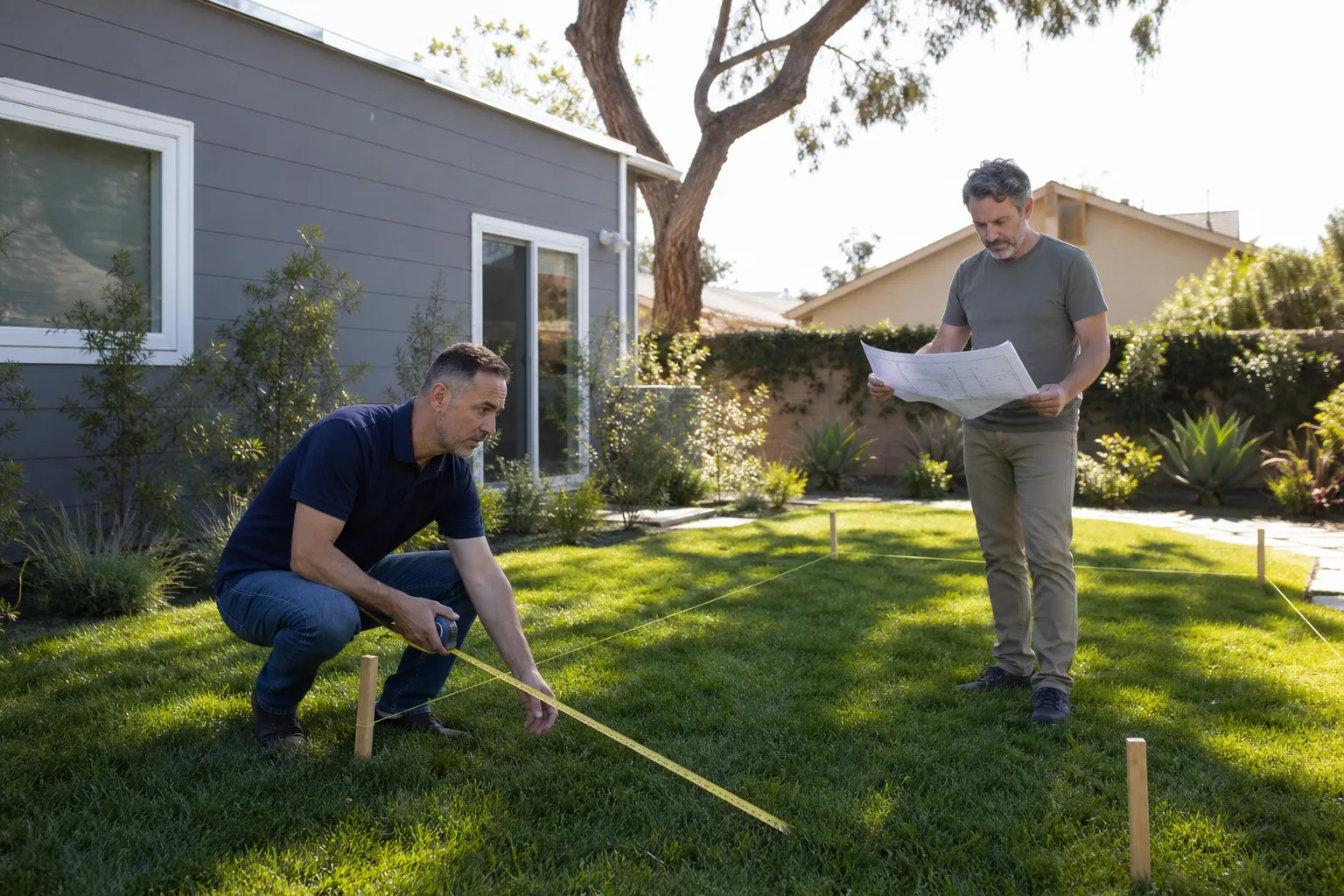
- Feasibility and parcel check. Confirm zoning, setbacks, and the existing sewer lateral size before you design anything. This is where the $8,000 – $22,000 connection fee becomes visible.
- Soil test and survey. Determine whether the lot has caliche and how the ADU will sit on the parcel. $600 – $12,000 depending on scope.
- Design and engineering. Plans drawn to Clark County’s requirements, with the foundation and mechanical systems specified.
- Permit submittal and review. Clark County reviews and issues the building permit. Plan review timing varies; we don’t quote a specific timeline because it depends on the county’s queue and the completeness of the submittal.
- Utility coordination. SNWA and NVEnergy applications, scheduling, and any meter upgrades.
- Construction. Foundation, then either site-built framing or prefab delivery and set, then mechanical rough-in, insulation, finishes, and final inspection.
- Final inspection and closeout. Clark County signs off, and you have a certificate of occupancy for the ADU.
Where builders cut corners in this sequence is at steps 1 and 5. Skipping the lateral check or deferring the utility applications until after the foundation is poured is how a $150,000 budget becomes a $185,000 one. A written scope and price at the start of this sequence is what keeps that from happening.
Common Mistakes to Avoid
- Assuming the online $150,000 ADU price applies to your Sunrise Manor lot. That number is a national median that assumes easy soil and existing utility capacity. A caliche lot with a small sewer lateral can run $30,000 – $40,000 higher before you change a single finish.
- Skipping the soil test to save $800. A geotechnical report on a caliche parcel is the cheapest part of the budget. Skipping it guarantees the excavation change order shows up after the concrete is on the truck.
- Getting a verbal estimate and treating it as a bid. Verbal estimates shift. On a project this size, a written price before any work starts is the baseline, not a nice-to-have.
- Cheaping out on the mechanical system in a desert climate. An undersized heat pump in a 110°F summer runs constantly, fails early, and costs more over ten years than the upgrade at install. Budget $8,000 – $14,000 for a properly sized system.
- Borrowing the full amount on a variable-rate HELOC without a payment plan. A HELOC at current variable rates is flexible, but the interest-only payment on a $180,000 line runs about $1,300 a month. Make sure the rental income and your own cash flow cover that before you sign.
- Believing the “pays for itself in five years” line. Running the actual Sunrise Manor rental math puts the break-even closer to 15 – 20 years on a financed build. Build for the right reason: housing or long-term equity, not a quick return.
- Choosing a lot location on the property without checking the utility run. Putting the ADU 80 feet from the main house versus 30 feet can add $5,000 – $10,000 in trenching and materials. Check before you pour the foundation.
When to Call a Professional
If you’ve gotten this far, you already know the ADU budget in Sunrise Manor is a stack of specific numbers, not a single figure. Call a professional when you need those numbers converted into a written price on your actual parcel, because that’s the step where the unknowns get resolved. You’ll want a professional for the Caliche soil assessment, the sewer lateral sizing, the snwa water meter application, the NVEnergy coordination, and the foundation engineering beyond what you can see. The prefab route with Abodu, Cover or a comparable brand still needs a site plan and a utility plan for the county to review it. Benson ADU Builders Sunrise Manor offers free estimates in Sunrise Manor. Call (844) 719-3308 to schedule yours.
Frequently Asked Questions
A 600-square-foot ADU in Sunrise Manor typically costs $145,000 – $250,000 in 2026, or roughly $240 – $420 per square foot. The range is wide because Clark County sewer connection fees ($8,000 – $22,000) and caliche-soil foundation costs move more from parcel to parcel than any other line item. Call (844) 719-3308 for an exact quote for your lot; estimates are free.
The county fee depends on your existing sewer lateral size and whether a new tap is required. If your lateral can handle the added load, you’re at the low end of the $8,000 – $22,000 range. If it can’t, you need a new tap and the cost moves toward $22,000. An older Sunrise Manor parcel from the 1950s or 1960s is the most likely to need a new tap.
It shouldn’t. We put the price in writing before any work starts, with the scope clearly defined. If an unknown like caliche or a smaller sewer lateral turns up during the soil test or lateral inspection, the change is disclosed and priced before work proceeds. That’s the point of the site check before the foundation is poured.
Yes. The ADU build process includes the Clark County building permit, the soil test, and the utility applications with SNWA and NVEnergy. Permit fees vary by square footage and valuation, and they show up in your written price as a line item rather than getting absorbed and marked up later.
The build itself usually runs four to six months on site once the foundation is in and the permit is issued, with the prefab route closer to the short end because panel delivery and assembly are faster than stick framing. Plan review and utility coordination add time before that. We won’t quote a specific total timeline because Clark County’s queue and the utility scheduling drive it, not us.
Usually, by about 10 – 15% on a mid-range build. A Cover or Abodu unit typically prices out below a comparable stick-built ADU because the on-site labor and weather exposure are shorter. The exception is a lot with unusual site constraints, where the prefab’s standard configuration doesn’t fit and stick-built offers more flexibility. Call (844) 719-3308 and we’ll compare both options on your specific parcel.
The Bottom Line
The Sunrise Manor ADU number is $145,000 to $250,000 for 600 square feet, and the reason it’s higher than the national median is two line items almost no cost guide mentions: Clark County sewer connection fees running $8,000 – $22,000, and caliche-soil foundations adding $5,000 – $10,000 over standard. Prefab brands like Cover and Abodu typically save 10 – 15% over stick-built on the same lot, and the honest break-even on a financed build sits closer to 15 – 20 years than the three-to-five years you’ll see quoted online. Get the soil test, size the sewer lateral, and put the price in writing before the first shovel turns. That’s the whole game.
Call (844) 719-3308 for a free estimate, and we’ll build the number for your actual Sunrise Manor parcel, not a national average.
Written by the team at Benson ADU Builders Sunrise Manor.