Last updated November 18, 2026
ADU Permits, Codes & Inspections in NV: What You Need to Know
A homeowner in Sunrise Manor submitted ADU plans in January, got the rejection notice in March, and learned the reviewer had applied a City of Las Vegas ordinance that doesn’t govern her unincorporated lot. Ten weeks gone. Roughly $3,200 in re-drawing fees on a project that never left the starting line. The problem wasn’t her design or her budget. It was a jurisdiction mix-up that a single phone call to the right office would have caught.
Nevada has no single statewide ADU code. What applies in Sunrise Manor is not what applies in Reno, Henderson, or North Las Vegas. This guide walks through who actually has authority over your lot, what the submittal packet needs, how the two review tracks work, how inspections get sequenced, and where the owner-builder exemption turns into a financing trap. If you’re building in Sunrise Manor, it’s written for your county specifically.
Quick Answer
For most Sunrise Manor properties, Clark County Development Services is the authority having jurisdiction (AHJ) over your ADU permit, not the City of Las Vegas. Plans are reviewed under the 2023 Clark County amendments to the IBC and IRC, which cover setbacks, height, lot coverage, and utility connections for accessory dwelling units. A complete submittal with a scaled site plan, detailed floor plan, energy compliance form, and sewer or septic documentation is the difference between a fast-track review and a multi-week standard cycle. Getting the wrong AHJ on your paperwork is the single most common reason ADU projects stall at plan check in Sunrise Manor.
Table of Contents
- Who Actually Has Authority Over Your Sunrise Manor ADU
- What Goes in the Submittal Packet
- The Two Review Tracks – and Which ADUs Qualify for the Faster One
- Inspection Sequencing, Start to Finish
- What a Failed Inspection Actually Costs
- The Owner-Builder Exemption and Its Hidden Cost
- How Prefab ADUs Change the Permit Math
- Common Mistakes to Avoid
Who Actually Has Authority Over Your Sunrise Manor ADU
Sunrise Manor is an unincorporated community in Clark County. That single fact changes everything about how your ADU gets permitted. If you live inside Las Vegas city limits, Henderson, or North Las Vegas, your permit routes through that city’s building department under that city’s ordinance. In Sunrise Manor, you’re dealing with Clark County Development Services as your AHJ.
This isn’t a minor technicality. Each jurisdiction maintains its own adopted code amendments, its own setback tables, its own review timelines, and its own interpretation of what counts as an ADU versus a JADU (junior accessory dwelling unit – a smaller unit built inside or attached to the primary home). A plan set drawn to City of Las Vegas standards will get flagged in Clark County for reasons that have nothing to do with whether the building is safe.
Here’s the pattern we see over and over in Sunrise Manor:
- A homeowner or designer pulls the wrong ordinance from a search engine, applies Las Vegas setbacks to an unincorporated lot, and the plan fails dimensional review on the first submittal.
- Someone assumes Clark County and City of Las Vegas have the same ADU size cap, then discovers mid-review that the county’s lot coverage calculation treats the ADU differently.
- A contractor licensed and experienced in Reno submits a packet that meets Washoe County standards but misses Clark County submittal requirements entirely.
The fix is simple: confirm your parcel’s jurisdiction before you draw a single line. Clark County’s parcel lookup and Development Services staff can tell you in one call whether your address falls under county or city authority. That confirmation belongs on page one of your project file, not discovered in a rejection letter.
If you’re building in Sunrise Manor and want the ADU scoped correctly from day one, our team at ADU Builders in Sunrise Manor starts every project with the jurisdiction question, not the floor plan.
What Goes in the Submittal Packet
Clark County reviewers reject incomplete submittals at a rate that surprises first-time builders. The packet isn’t complicated, but every document has a minimum standard, and missing one holds the entire file. Here’s what a complete ADU submittal for a Sunrise Manor property needs:
- Site plan at the required scale. Show the lot lines, the primary home footprint, the proposed ADU footprint, all setbacks dimensioned from property line to structure, driveway and parking, and utility easements. Reviewers want to see the setback measurement, not just the building outline.
- Floor plan with minimum detail. Room dimensions, wall thicknesses, door and window sizes and swing, egress paths from every sleeping room, and the location of smoke and carbon monoxide alarms.
- Energy compliance documentation. Nevada’s energy code is enforced through a compliance form specific to the state’s adopted standard. Every ADU submittal needs it, whether the unit is site-built or prefab panel construction.
- Septic versus sewer documentation. If your Sunrise Manor lot connects to a public sewer system, you need the connection documentation. If it’s on septic, you need the engineered septic design and the county health department’s signoff on capacity for the additional unit. This is the document that stalls the most projects, because septic capacity for a second dwelling has to be proven, not assumed.
- Structural calculations for site-built units. Prefab units typically arrive with engineered plans and stamped calculations from the manufacturer, which shortens the review significantly. Site-built ADUs need a structural package prepared by a Nevada-licensed engineer.
- Title 24 equivalent compliance. Confirm energy compliance documentation matches the current adopted Nevada standard. An outdated form gets the file back in your hands.
One more habit worth building: call the county before you submit. Development Services staff will tell you what’s changed since the last packet you saw. Codes get amended, forms get updated, and the version of the submittal checklist you downloaded last year may not match what the counter is asking for today.
The Two Review Tracks – and Which ADUs Qualify for the Faster One
Clark County runs two review tracks for residential permits, and the difference between them is measured in weeks. Which track your ADU lands on is largely determined before you submit.
Over-the-counter review is the faster track. You hand the plans to a reviewer at the counter, they review in real time, and you walk out with comments or an approval. It handles straightforward projects: standard rectangular footprints, clear site plans, prefab units with complete manufacturer documentation, and no unusual structural or utility conditions. A clean prefab ADU from a brand like Cover or Boxabl – units engineered and documented to a repeatable standard – is far more likely to qualify for this track than a custom site-built design with a cantilevered roof and a hillside footing.
Standard review is the multi-week track. It routes your packet through multiple reviewers: planning, building, fire, and engineering. Complex site conditions, non-standard structural designs, septic capacity questions, and any ADU that requires a setback variance go here. Expect weeks, not days.
What pushes a Sunrise Manor project from fast track to standard review:
- A site plan with missing setback dimensions or an unclear property line
- Septic capacity documentation that doesn’t clearly show capacity for the added unit
- A design with any element outside prescriptive code – a non-standard foundation, unusual roof pitch, or complex egress path
- Requests for a setback reduction or lot coverage variance
- Submittals with incomplete energy compliance forms
In our experience, the biggest lever on review time isn’t the design complexity. It’s submittal completeness. A simple ADU with a sloppy packet goes to standard review. A well-documented prefab unit with every form in order goes over the counter. Getting the packet right the first time is worth more than any shortcut.
For the design-side scope of an ADU versus a home addition, our Home Addition Contractor in Sunrise Manor page covers where the two projects overlap and where the permit paths split.
Inspection Sequencing, Start to Finish
The permit gets you approved to build. Inspections get you approved to occupy. Clark County requires an inspection at each major phase, and the sequence is not optional – you can’t frame before the foundation passes, and you can’t insulate before the rough electrical and plumbing clear.
- Foundation inspection. Called after forms and rebar are set, before concrete is poured. The inspector checks footing dimensions, rebar placement, and anchor bolt locations.
- Framing inspection. Called after the structure is standing and sheathed, before insulation goes in. Checks stud spacing, headers, shear nailing, and roof connections.
- Rough MEP inspection. MEP means mechanical, electrical, and plumbing – the systems inside your walls. This inspection covers the ductwork, wiring runs, and drain and supply lines while the walls are still open. One inspector often handles all three; sometimes it’s separate appointments.
- Insulation inspection. Called after insulation is installed and before drywall covers it. Energy compliance documentation is checked against what’s actually in the walls.
- Final inspection. Called after everything is finished, painted, and connected. Covers all systems, egress, alarms, and the exterior. The certificate of occupancy follows.
Each inspection needs the permit on site, the approved plans available, and the work at the exact stage the inspector expects. Calling for a framing inspection before the roof sheathing is on gets you sent home. Calling for rough MEP before the plumbing is pressure-tested gets the same result. The schedule is driven by the inspector’s availability, and Clark County books out – which means a missed inspection can cost you a week of schedule waiting for the next slot.
Build the inspection calendar into your project timeline before work starts. A site-built ADU in Sunrise Manor typically hits five inspection milestones. A prefab unit still needs foundation, utility rough-in, and final, but the factory-built modules arrive already inspected at the plant, which cuts both the on-site sequencing and the wait time between phases.
What a Failed Inspection Actually Costs
A failed inspection reads like a minor setback. It isn’t. Here’s what it costs in real dollars and real days.
The re-inspection fee. Clark County charges a re-inspection fee for the second visit. The exact amount depends on the permit type and how many reinspections stack up, but it’s a line item that didn’t have to exist.
The schedule days. This is the bigger cost. A failed inspection can push your project back anywhere from three to ten days, depending on how backed up the inspector schedule is and how fast your crew can make the correction. Corrrections that require a sub-trade – an electrician who has to come back out for a residential panel issue – can add another week on top.
The downstream cascade. Miss your framing inspection and your insulation crew that was scheduled for Tuesday now sits idle. Miss your insulation and the drywall hanger cancels. Each trade is on its own schedule, and a failed inspection in the middle of the sequence costs you deposit money, rescheduling fees, and in the worst case a crew that moves to a different job and comes back next month.
The pattern we watch for in Sunrise Manor: homeowners push an inspection early to hit a deadline, the work isn’t ready, and the failed inspection resets the clock. Let the work reach the stage before you call. A one-day delay to hit the inspection clean is always cheaper than a failed inspection and its downstream reschedule.
The Owner-Builder Exemption and Its Hidden Cost
Nevada allows a homeowner to pull an owner-builder permit for their own residence – you act as your own general contractor, hire whatever trades you want, and carry the construction liability yourself. For an ADU, this exemption is legal, and it’s the single biggest cost-saving option available. It’s also the one that most often blows up a homeowner’s financing.
Here’s the trade. As an owner-builder, you take on the general contractor’s role: scheduling inspections, coordinating trades, holding the permit, and carrying the liability for any defect in the work. If a sub-trade installs the drain wrong and it fails two years later, the county isn’t going to help you. You own that defect. Most owner-builders are capable of the coordination. Fewer are prepared for the liability.
The bigger issue is what the permit does to your property’s financing profile. Most mortgage lenders won’t finance a property with an owner-builder ADU permit on record, because the lender can’t verify the construction was completed by a licensed contractor. If you sell the property, a buyer’s lender sees that owner-builder permit in the county records and often declines – or requires a full construction documentation review before approving. That’s a six-figure problem hiding in a $600 permit fee.
When the owner-builder route makes sense:
- You have a genuine construction background and can manage trades directly
- You’re paying cash and don’t plan to sell the property in the near term
- You’ve confirmed with your lender that the owner-builder permit won’t affect your financing
When it doesn’t: if you’re financing the ADU, if you plan to sell within a decade, or if you don’t want to carry the defect liability yourself. In those cases, a licensed general contractor pulling the permit – with the ADU built to lender-ready documentation – protects the property’s resale value and the financing.
How Prefab ADUs Change the Permit Math
Prefab ADUs are built in modules at a factory, engineered to a repeatable standard, and delivered complete with inspection documentation from the plant. That doesn’t eliminate the Clark County permit, but it changes what the county reviews on-site and how fast the approval tends to move.
What stays the same: the site plan, the setback dimensions for your Sunrise Manor lot, the sewer or septic documentation, the energy compliance form, and the foundation inspection. The county is still checking that the unit fits legally on your property.
What changes: the structural design and the interior systems arrive with manufacturer engineering documentation. A prefab unit from a brand like Dvele or Mighty Buildings comes with stamped plans that reduce the structural review time, and the fire separation and egress documentation is typically pre-verified for the model. That’s what makes prefab units more likely to qualify for over-the-counter review.
For Sunrise Manor homeowners who want a finished ADU without managing a full site-build, prefab is often the cleaner permit path. We build with and source from the leading prefab brands – Abodu, Cover, Dvele, Mighty Buildings, Boxabl, Plant Prefab, and Tuff Shed – so homeowners can compare models, research the engineering independently, and pick a unit where the permit packet is already proven in Clark County.
If you’re weighing a site-built room addition against a detached ADU, our Room Addition Contractor in Sunrise Manor page covers the permit differences, and the Benson ADU Builders Sunrise Manor home page is the place to start when you’re ready to price a project.
Common Mistakes to Avoid
- Applying the wrong city’s code. Building to City of Las Vegas standards on an unincorporated Sunrise Manor lot is the most frequent plan-check failure. Confirm your jurisdiction before drawing.
- Assuming septic capacity without engineering proof. A Sunrise Manor lot on septic needs documented capacity for the second dwelling. Reviewers won’t accept an assumption.
- Submitting an incomplete energy compliance form. Every ADU submittal needs current Nevada energy compliance documentation, and an outdated form sends the file back without review.
- Rushing an inspection before the work is ready. A failed framing or rough MEP inspection costs re-inspection fees plus three to ten schedule days, and the downstream trade reschedules cost more than the fee.
- Using the owner-builder permit without talking to your lender. Most lenders won’t finance a property with an owner-builder ADU permit on record, and that affects your resale, not just your construction loan.
- Treating the submittal checklist as static. Clark County amends forms and submittal requirements. Call Development Services before you submit, not after the rejection.
- Skipping the counter call. The over-the-counter review track saves weeks when the packet is clean. A five-minute call before submittal tells you what the counter expects today.
When to Call a Professional

Some ADU permit questions are worth a call and some aren’t. If you’re unsure which jurisdiction governs your Sunrise Manor parcel, if your lot is on septic and you need to prove capacity for a second dwelling, or if your design has any element outside prescriptive code – a hillside footing, a non-standard roof, a setback variance – a licensed professional who’s submitted ADU packets to Clark County Development Services will save you the re-drawing cycle. The same holds if you’re considering the owner-builder permit and want a straight answer about the financing and resale implications before you commit.
Benson ADU Builders Sunrise Manor offers free estimates in Sunrise Manor. We put the price in writing before any work starts, we build with the prefab brands you can research independently, and every project carries the 365-Day Done Right Promise in writing. Call (844) 719-3308 to schedule your free estimate.
Frequently Asked Questions
Clark County Development Services is the authority having jurisdiction for ADU permits on most Sunrise Manor properties, because Sunrise Manor is unincorporated county land rather than inside Las Vegas city limits. Your parcel’s jurisdiction determines which adopted code amendments apply, so confirm it before you submit any plans.
Clark County permit fees for an ADU depend on the project valuation and the specific permit types – separate fees can apply for building, electrical, plumbing, mechanical, and septic review. Call (844) 719-3308 for an estimate on a full project where the permit costs are itemized in a written scope before work starts.
Nevada allows a homeowner to pull an owner-builder permit for their own residence, and that includes an ADU. The catch is that you carry the construction liability yourself and most mortgage lenders won’t finance a property with an owner-builder ADU permit on record – a re-sale problem that outweighs the permit-fee savings for many homeowners.
Yes. A prefab ADU built by Cover, Dvele, Boxabl, or a comparable brand still requires a Clark County building permit, site plan approval, and foundation inspection. The factory engineering documentation shortens the structural review and makes the unit more likely to qualify for over-the-counter review, but the county still confirms the unit fits legally on your lot.
Over-the-counter review handles a complete, straightforward submittal at the counter in a single visit. Standard review routes the packet through multiple departments and takes weeks. Submittal completeness – full site plan, detailed floor plan, energy form, sewer or septic documentation – is the main determinant of which track your project lands on.
A failed inspection triggers a re-inspection fee and pushes your schedule back three to ten days, plus the cost of rescheduling any trades whose work depends on the next phase clearing. Call (844) 719-3308 for a project scoped from the start with the inspection milestones built into the timeline.
The Bottom Line
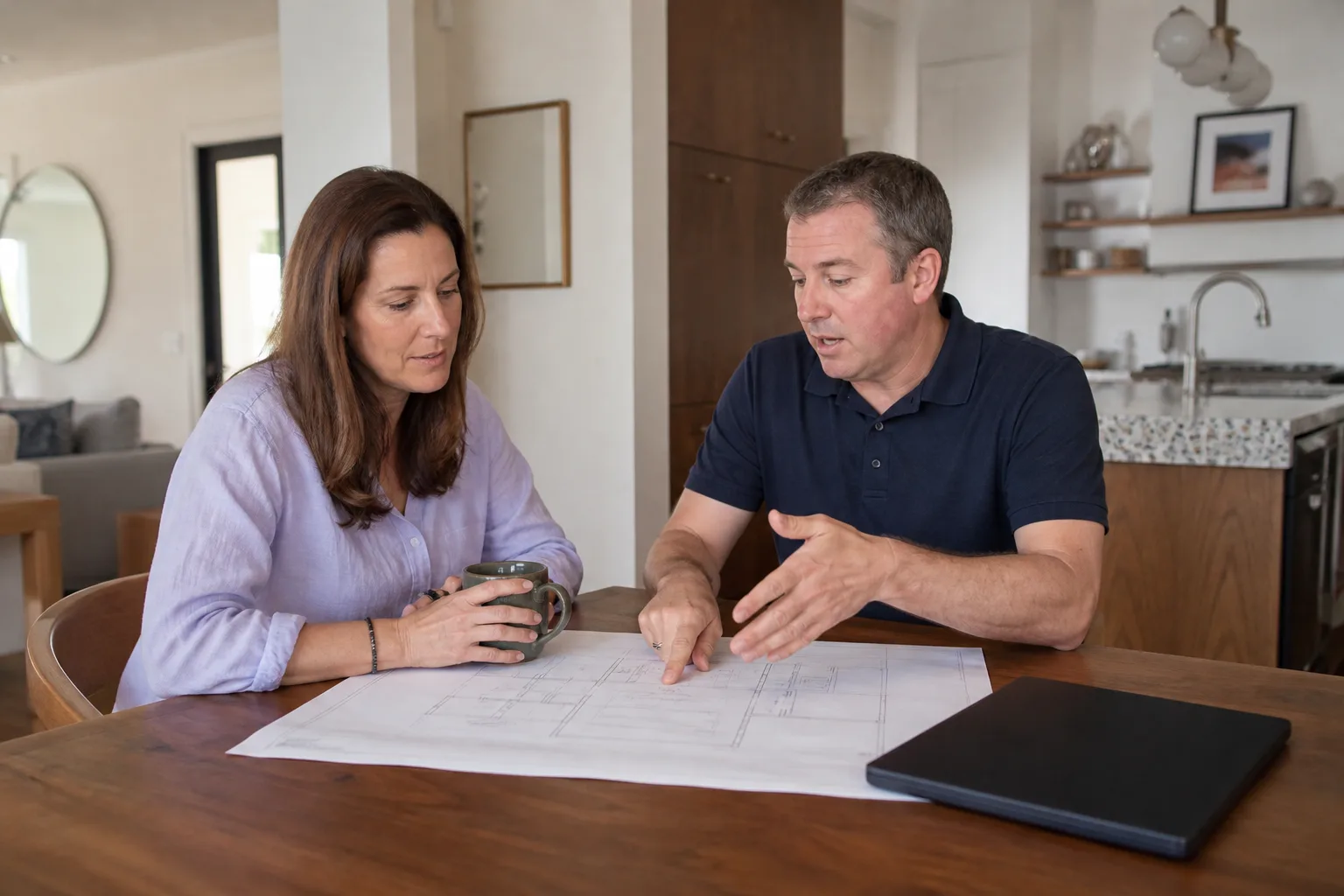
Nevada’s ADU rules live with the local jurisdiction, not the state. In Sunrise Manor, that means Clark County Development Services is your AHJ, and the 2023 Clark County amendments to the IBC and IRC govern your setbacks, height, lot coverage, and utility connections. A complete submittal – scaled site plan, detailed floor plan, energy compliance form, and clear sewer or septic documentation – is what gets you onto the faster over-the-counter track instead of the multi-week standard review. Build the inspection sequence into your calendar before work starts, understand what a failed inspection actually costs in dollars and schedule days, and think hard about the owner-builder permit before you use it, because it can block your financing and your resale. Get the jurisdiction right and the packet complete, and the rest of the process works the way it’s supposed to.
Written by the team at Benson ADU Builders Sunrise Manor.